

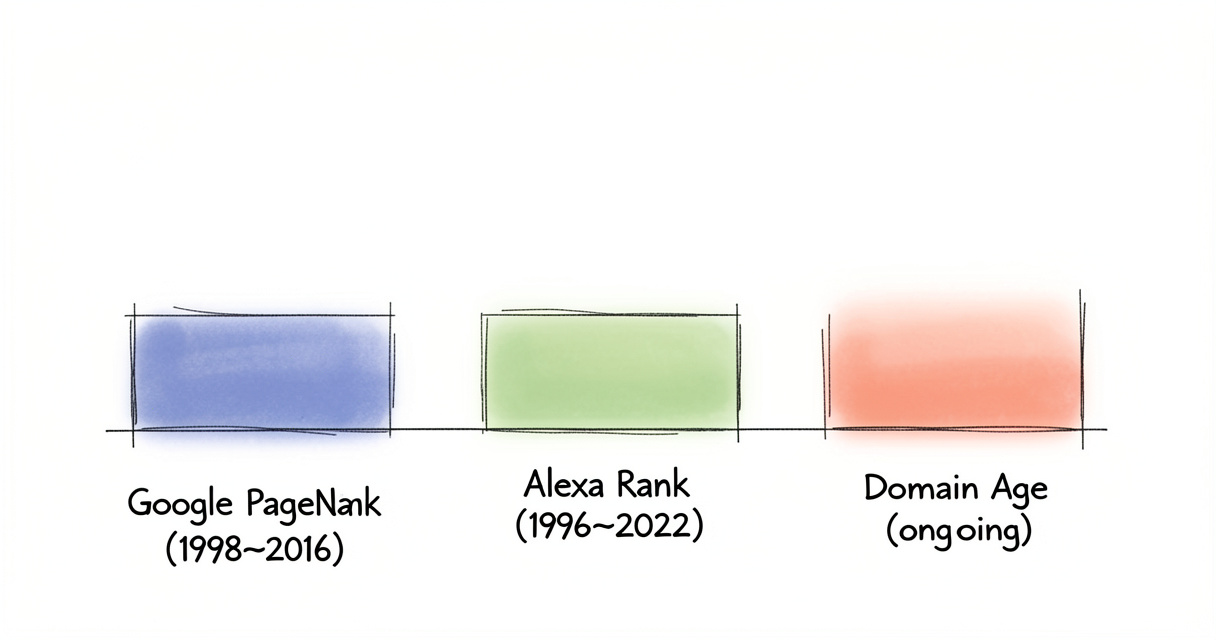
Domain age, PageRank, and Alexa Rank are often presented as if they were three current SEO scores. They are not. One is a registration-history clue, one is still part of Google’s link-analysis systems but has no public score, and one is a retired traffic estimate.
The useful question is not how old a domain looks in a checker. It is what its history can actually tell you, which measurements Google still publishes, and whether a number helps you make a better decision.
Updated October 23, 2026
Key takeaways
- A registration date is not the same as the age of a website, its content, or its presence in Google’s index.
- Google says PageRank remains one of its core ranking systems. The old public Toolbar score is not a current measurement of it.
- Alexa Rank is a historical product, not a live SEO metric. Alexa.com’s web service was retired in 2022.
- Use Search Console to measure Google Search visibility and your own analytics to measure visits and business outcomes. Treat third-party estimates as estimates.
What Is Domain Age? A Practical Definition
“Domain age” sounds like one date. In practice, people use it for several different timelines: when a name was first registered, when a working website appeared on it, when useful content was published, and when a search engine first discovered or indexed that content. Those dates can be years apart.
A registration date describes the name, not the website
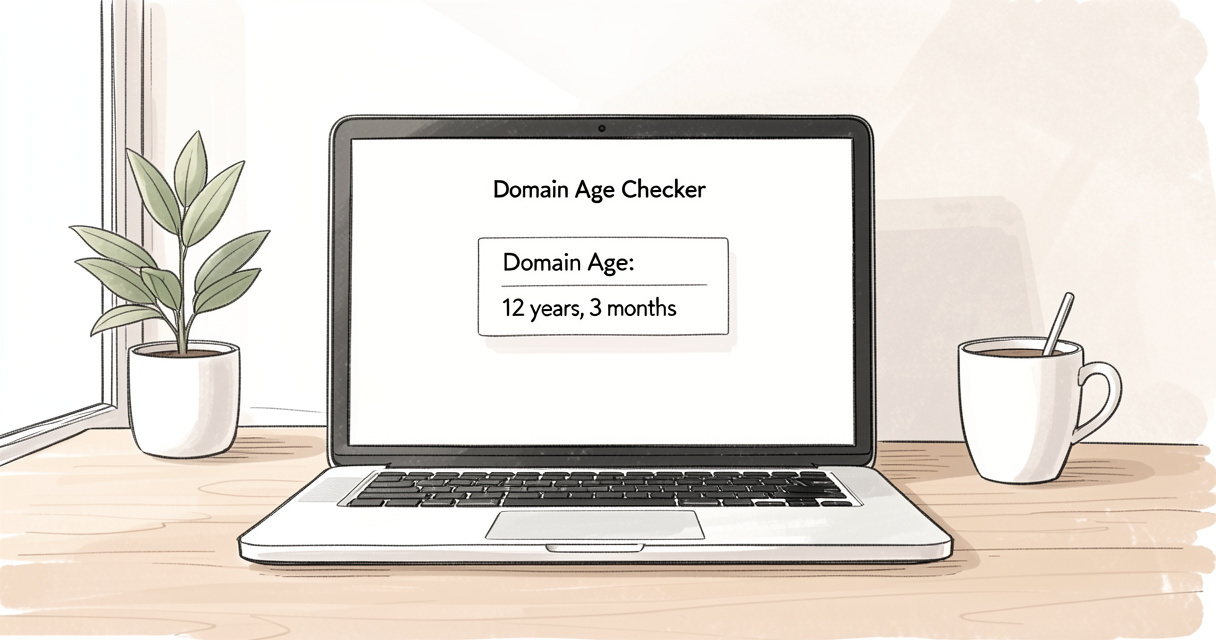
A domain-age checker usually reports a registration or creation date found in public registration data. ICANN’s lookup tool uses RDAP to show currently available registration records, with a WHOIS fallback when information is not available through RDAP. That can answer a narrow question: when was this domain name registered according to the available record?
It cannot tell you whether the domain hosted a useful site for all those years, whether the current owner built the same business, or when Google first crawled a page. Registration records may also be incomplete or privacy-protected. A checker can help you inspect a name; it cannot produce a Google ranking score.
ICANN Registration Data Lookup is a primary place to check current registration information. For a purchase or migration, combine that record with the domain’s visible history, current pages, redirects, and backlink profile. Do not treat the oldest date in one database as a complete history of the site.
A long history can be useful context, but it is not proof of authority
An older domain may have a long archive, mentions, links, and an established audience. Those are separate facts worth checking. The calendar age itself does not prove that the links are relevant, that past content was trustworthy, or that the current site continues the same purpose.
Ownership changes are not a magic explanation for a ranking drop. The public documentation does not establish a rule that a new registrant automatically triggers a timed “sandbox.” If a site changes hands, inspect what changed: topic, content quality, redirects, technical setup, and whether the pages still meet a real audience need.
Google PageRank: Dead or Alive?
PageRank is both a piece of search history and a current concept. The confusion comes from treating Google’s internal link-analysis system and the old public Toolbar number as the same thing.
The public score disappeared; the system did not
PageRank began as a way to evaluate links between pages. Google’s current ranking-systems guide says PageRank remains one of its core systems and that the way it works has evolved substantially. That confirms the system still exists; it does not reveal a score for any particular page or explain how much weight a link has in a specific search.
The old public Toolbar display is gone. Google had already explained that its displayed PageRank was different from the number used by its ranking algorithm and updated only occasionally. It was never a dependable business outcome. A modern checker that presents a neat “PageRank” number is not connected to Google’s private calculation.
Google’s guide to ranking systems describes PageRank as one part of a larger set of systems. Its older explanation, Beyond PageRank: Graduating to actionable metrics, also warns that the public display was not the same as the internal ranking value.
Third-party authority scores are not Google PageRank
SEO platforms may calculate their own scores from links, estimated traffic, or other collected data. These can help compare a set of sites inside one tool, but their scales and models differ. A score of 40 in one platform is not interchangeable with a score of 40 in another, and neither is a Google metric.
Use link databases to find patterns that deserve investigation: relevant referring pages, suspicious spikes, lost links, or a gap between competitors. Then inspect the pages and the context of those links. The score is a shortcut for prioritizing research, not a verdict on quality or a forecast of rankings.
What to do instead of chasing a toolbar number
Build pages that deserve to be referenced, make them easy to find and use, and measure what happens after people arrive. Google’s spam policies warn against link schemes intended to manipulate rankings. Buying a metric or a promise of “PageRank increase” does not create useful recommendations from real publishers.
Alexa Rank: Rise and Fall
Alexa Rank once gave marketers a simple-looking answer to a hard question: how much traffic does this site receive compared with other sites? The number was attractive because it reduced a complex estimate to a single position. It was also easy to misunderstand.
An estimated audience is not a search-performance report
Alexa Rank was a comparative estimate produced from Alexa’s own data and methodology. It was not a count of every visit, a ranking position in Google, or a measure of whether a page answered a search well. Like any panel-based or modeled estimate, its usefulness depended on coverage, assumptions, and the population being measured.
A site could move up or down in a third-party estimate while its own Search Console clicks or analytics sessions moved differently. That does not automatically mean one source is dishonest; the tools measure different things. It means the number must be read with its method and limitations in mind.
Alexa.com’s web-ranking service was retired in 2022
Alexa announced that Alexa.com would be retired on May 1, 2022. The service is no longer a current source for a site’s traffic rank. Its old values may still appear in archived articles, screenshots, and saved reports, but they should be treated as historical snapshots with a specific date, not live performance data. The retirement notice explains the shutdown.
What replaced Alexa Rank?
There is no single replacement that reproduces Alexa’s number and meaning. Competitive intelligence products estimate traffic from their own datasets and models. They can be useful for directional comparisons across a consistent set of sites, but the estimates can differ because each provider observes and models the web differently.
For your own website, use first-party data for the question it can answer. Search Console reports how your pages appeared and were clicked in Google Search. Analytics reports visits and activity captured by your implementation. Neither is a universal view of every audience source, and neither is a direct substitute for the other. A competitor estimate remains just that: an estimate.
Does Domain Age Impact SEO?
The careful answer is that public evidence does not support a reliable, standalone “older domain bonus” that a checker can measure. Google’s published ranking guide describes many systems and signals, including PageRank and an exact-match-domain system, but does not present registration age as a named ranking system or public score. That is a limit on what we can claim—not proof that no age-related information is ever used inside a private system.
Why older sites can appear stronger
Age and accumulated assets often travel together. A site that has operated for years may have earned relevant links, published useful material, developed a recognizable name, and learned what its audience needs. Those assets can help. The domain’s birthday is not a substitute for checking whether the assets exist, remain relevant, and still support the current pages.
Consider two hypothetical sites. One is ten years old but has outdated pages and unrelated links. The other is new and publishes a clear, well-supported answer for a specific audience. The older date alone does not tell you which page Google should show. Relevance, content, links, and many other signals interact, and the outcome can vary by query.
The “Google sandbox” is not a fixed 3–6 month rule
New pages and sites can take time to be discovered, crawled, indexed, and evaluated. Google’s documentation explains that Search works through crawling, indexing, and serving, and that inclusion is not guaranteed. A delay does not prove a timed penalty. There is no dependable public formula that says a new domain must wait a fixed number of months before it can rank.
When a new site is slow to gain visibility, check concrete causes: whether important pages are crawlable, whether the pages provide a distinct answer, whether the site has clear internal links, and whether the target queries match the content. A calendar countdown cannot diagnose those problems. See Google’s explanation of how Search works before calling every delay a sandbox.
Expired domains need a history review, not an age premium
An expired domain may have a history worth preserving, or a history that is irrelevant to the new project. Review its previous topic, archived pages, redirect patterns, and incoming links before you build on it. Google defines expired-domain abuse as repurposing an expired domain primarily to manipulate rankings with low-value content. Using an older name for a genuinely useful, original site is not automatically abuse; the purpose and value of the content matter. Read the current spam policies before treating a past reputation as an SEO shortcut.
Beyond the Old Metrics: What Actually Matters in 2026
Replacing one magic score with another does not improve a site. The better approach is to identify what is holding a page back, change something that addresses that problem, and track the result over a period that makes sense for the query.
Useful, accurate content that fits the query
Start with the reader’s task. Does the page answer the question directly? Are key claims sourced? Is the explanation complete enough to help someone act? Does the page add information or analysis beyond repeating what is already everywhere? Google’s people-first guidance recommends checking for original value, a clear purpose, a satisfying answer, and easily verifiable factual errors.
E-E-A-T—experience, expertise, authoritativeness, and trustworthiness—is a way of describing qualities that can help systems identify reliable content. Google says E-E-A-T itself is not a specific ranking factor. Do not treat it as a score to paste into a page. Show readers who is responsible, how claims were researched, and where the information comes from. Use relevant first-hand experience only when it is real and useful.
Google’s people-first content guidance is a better editorial checklist than a fabricated authority number.
A good page experience without a perfect-score obsession
Pages should load reliably, work on mobile, make the main content easy to find, and avoid obstacles that interrupt reading. Google says Core Web Vitals are used by its ranking systems, but also says there is no single page-experience signal and good scores do not guarantee top rankings. Measure real problems and fix those that affect visitors; chasing a perfect tool score for its own sake can waste time.
See Google’s page-experience documentation for the distinction between Core Web Vitals and the broader experience of using a page.
Freshness where the query needs it
Some searches call for current information; others call for a stable explanation. Updating a date without improving the answer does not make an article more useful. Review pages when facts, products, law, software, or the searcher’s needs have changed, and show what was actually updated. A domain’s age cannot rescue stale information, and a new publication date cannot manufacture freshness.
Links and reputation in context
Links can help search systems understand how pages relate and which sources people reference. Their value depends on context, not a third-party score alone. Look for relevant, editorially meaningful references and a site history that fits the current topic. Avoid schemes designed to manufacture ranking signals; the short-term number is not worth the risk to readers or the site.
How to Check These Metrics: Tools and Limits
Choose a tool after you define the question. A domain lookup, a Search Console report, and an audience estimate are not competing answers to the same measurement.
| Question | Useful source | What it can tell you | What it cannot tell you |
|---|---|---|---|
| When was the name registered? | ICANN RDAP lookup or the relevant registry | Available registration-record dates and status | When the current site began, what Google indexed, or whether the domain ranks well |
| How did a page appear in Google Search? | Google Search Console | Clicks, impressions, CTR, average position, and query/page dimensions | Every search, every visitor, or a guaranteed rank for one person |
| How many visits did my own site receive? | Your analytics implementation and server logs | Visits or requests captured by that setup and the events it records | Search position by themselves, or untracked visits outside the measurement setup |
| How large might a competitor’s audience be? | A third-party traffic-estimation platform | A modeled, directional comparison under that provider’s methodology | An exact competitor traffic count or an interchangeable Alexa Rank |
| What is my Google PageRank score? | No public Google tool provides the internal score | Google’s documentation confirms PageRank remains a system | A current page-level PageRank number from an unofficial checker |
Read Search Console by page, query, and comparable dates
Search Console separates clicks, impressions, click-through rate, and average position. Filter to the exact page and the relevant search type, then compare periods of equal length and similar seasonality. Position is an average across impressions, not a fixed rank that every searcher sees. A change in the mix of queries can move the average even if no single query changed in the way the headline number suggests.
Use Google’s Search Console Performance report guide to understand the available dimensions and metrics. Keep property-level totals separate from page-level rows, and do not read missing report data as proof of zero demand.
Use analytics for audience outcomes, not ranking folklore
For your own site, connect search visibility to the outcome that matters: qualified visits, sign-ups, sales, or another real goal. Analytics depends on correct tagging and consent settings; server logs count requests and may include automated traffic. Write down what each source measures before comparing numbers. Mixing visits, impressions, and estimated monthly traffic creates a chart, not an explanation.
Frequently Asked Questions
Does an older domain automatically rank higher?
No public evidence supports a simple age bonus that applies automatically. Older sites may have accumulated useful content, relevant links, and recognition over time, but those assets should be checked directly. A registration date alone does not predict a page’s position.
Is PageRank still used by Google?
Yes. Google’s current ranking-systems guide says PageRank remains one of its core systems. The public Toolbar number is gone, and no third-party score is the same as Google’s internal calculation.
Can I check my current Google PageRank?
No. Google does not publish a current PageRank score for each page. Treat tools that claim to reveal that number as unofficial estimates or mislabeled metrics, and avoid using them as a target.
Did Alexa Rank shut down?
Alexa.com’s web-ranking service was retired on May 1, 2022. Any Alexa Rank you see today is historical or cached, not a live measure of a site’s traffic.
How long does a new domain take to rank?
There is no fixed public waiting period. Discovery, crawling, indexing, competition, and the value of the pages all affect the path. Check crawlability and Search Console evidence instead of assuming a universal three-to-six-month sandbox.
Conclusion: Measure the Work, Not the Birthday
Domain age can help you ask better questions about a site’s past. It cannot tell you whether that history is relevant or whether a page deserves to rank. PageRank still exists inside Google, but its old public score is not available. Alexa Rank belongs in the history books.
Three actions to take today
- Check registration data only when you need to verify a domain name’s record; inspect the site’s actual history separately.
- Replace public-score chasing with page-level Search Console trends and the audience outcomes you care about.
- Improve the page that people land on: make its answer accurate, useful, easy to access, and supported by sources readers can verify.
Slow down. Think. The number that matters is the one connected to a real decision.

Building websites since before Google existed. I’ve run SEO, growth, and content for startups across California — and I’ve watched every ‘revolutionary’ tactic eventually expire. What doesn’t expire: understanding systems, compounding effort, and thinking slower than everyone else.