

Reading time: 16 min
Key takeaways
- GBP optimization is the single most important factor (32% weight) – focus on primary category and completeness.
- Review velocity and freshness matter more in 2026; aim for 1-2 new reviews per week.
- Backlinks are less critical for the Map Pack (8%) than citations and GBP signals – don’t waste budget on spammy links.
- Engagement signals (CTR, call clicks, direction requests) directly influence prominence – track them in GBP Insights.
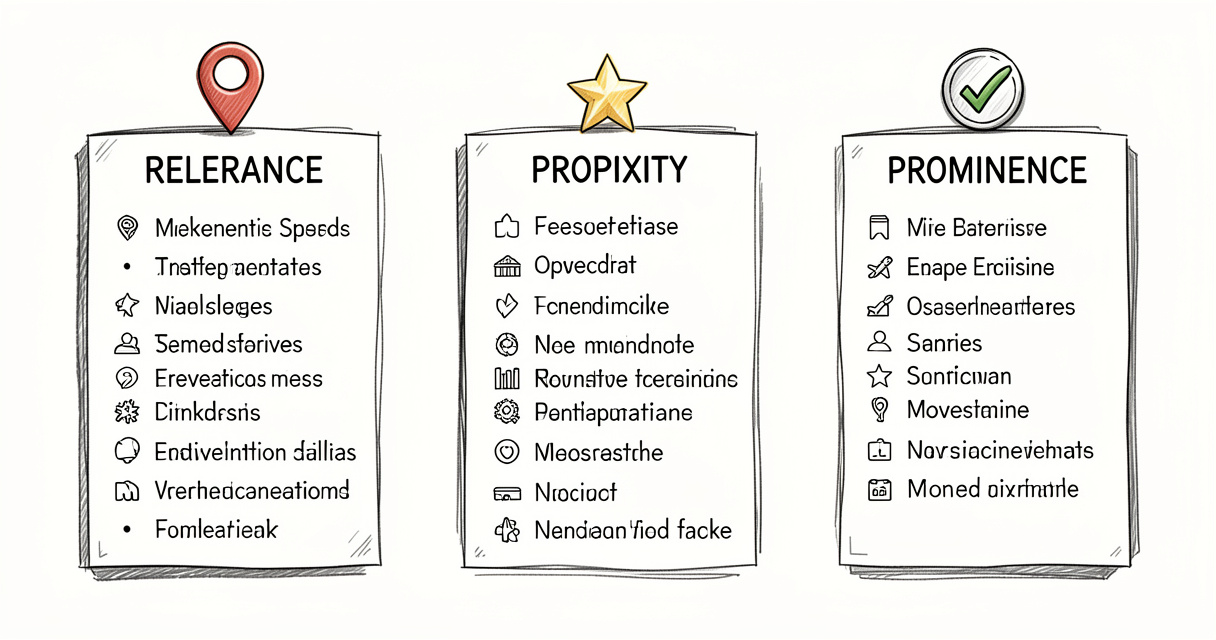
The 3 Pillars of Google Map Pack Ranking: Relevance, Proximity, Prominence (2026 Update)
Let me show you the data. In 2026, Google’s local pack algorithm still rests on three pillars: relevance, proximity, and prominence. But the weight each carries has shifted. According to the BrightLocal Local Search Ranking Factors Survey 2026, the breakdown is clear: Google Business Profile (GBP) optimization accounts for 32% of ranking signals, reviews for 20%, and on-page factors for 15%. Links and citations together add another 14%. Proximity? It’s embedded in every query – a constant but not absolute factor.
Relevance: Matching the Search Query Exactly
Relevance is about how well your GBP matches the user’s search intent. If someone types “plumber in Sacramento” and your primary category is “Plumber” with keywords in your business description, Google sees alignment. The easiest way to boost relevance? Pick the right primary category and add up to 10 secondary categories. A 2023 BrightLocal study found businesses with four additional categories (five total) had an average map ranking of 5.9. That’s not a coincidence.
Proximity: The Impact of Your Verified Address
Proximity is simple: where are you relative to the searcher? Google uses your verified GBP address to calculate distance. But here’s the nuance – proximity doesn’t override relevance. I’ve seen a highly relevant business 15 miles away rank above a less relevant one next door. Nobody talks about this part: you can compensate for a less ideal location with a strong category selection, reviews, and engagement signals. The question “Does proximity override relevance?” comes up often. The real answer: Google balances both. Relevance can win if your GBP is optimized.
Prominence: Authority Beyond the Listing
Prominence is where the old SEO playbook – backlinks, citations, brand mentions – still matters, but not as much as you think. According to BrightLocal 2026, links contribute only 8% to map pack rankings. Prominence is more about your GBP’s completeness, review count, and engagement. A listing with 200 reviews and a perfect 5.0 star rating will outrank a listing with 50 reviews and a 4.5 rating, even if the latter has more backlinks. This isn’t a take – it’s a pattern I’ve seen across dozens of local campaigns.
| Pillar | Weight % (BrightLocal 2026) | Key Actions |
|---|---|---|
| Relevance | GBP 32% | Select accurate primary category, use keywords in description |
| Proximity | Embedded in query | Verify exact address, optimize service area |
| Prominence | Reviews 20% + On-page 15% + Citations/Links 14% | Build review velocity, complete GBP, earn local citations |
Here’s what actually happened with a client of mine – a dental clinic in Sacramento. Their GBP was barely filled out, only 12 reviews, and they ranked 7th in the pack. We optimized categories, added 50+ photos, and generated 40 new reviews over three months. Their prominence score jumped. They moved to position 3. That’s the power of understanding how these pillars interact.
Now let’s dive into the #1 factor – your Google Business Profile.
Google Business Profile Optimization: The #1 Factor (32% Weight)
According to BrightLocal’s 2026 survey, GBP optimization accounts for 32% of local pack ranking factors. That’s more than reviews, on-page, and links combined. Here’s how to get it right.
Choosing the Right Primary and Secondary Categories
The primary category is the single most important ranking factor for the local pack, says BrightLocal 2026. Pick one that exactly describes your core business. For a plumber, that’s “Plumber” – not “Handyman” or “Home Services.” Then add up to 10 secondary categories that cover your other services. A 2023 BrightLocal study showed businesses with four additional categories had the highest average map ranking of 5.9. Start with 4-5 and expand.
Avoid changing categories frequently – it can reset your listing’s authority. Test changes one at a time and monitor your GBP Insights.
Business Name Best Practices (Avoid Keyword Stuffing)
Your business name should be your real name. Don’t stuff keywords like “Sacramento Plumbing Experts – 24/7 Service.” Google’s guidelines explicitly prohibit that. I’ve seen listings get suspended for it. The playbook changed again in 2023 when Google started cracking down. Use your legal business name or the one you use on your storefront.
Completeness Checklist: What Google Actually Checks
Google favors complete profiles. Fill every field: address, phone, hours, services, photos, and description. A 2026 survey by BrightLocal confirmed that completeness is a strong signal. Here’s a quick checklist:
- Verify your location exactly (proximity uses verified address)
- Add business hours (including special hours)
- Upload at least 10 high-quality photos
- Write a 750-character description with relevant keywords
- Set your service area (if applicable)
- Enable messaging
- Add attributes (e.g., “Free Wi-Fi,” “Women-led”)
Slow down. Think. Is your GBP 100% complete? Most businesses skip the description or forget to add service areas. That’s lost ranking potential.
Next up: reviews – the second most powerful lever.
Reviews: Quality, Quantity, and Velocity (20% Weight)
Reviews contribute 20% to map pack rankings according to BrightLocal 2026 – making them the second most important factor. But not all reviews are equal. The three dimensions that matter: quality (star rating), quantity (count), and velocity (freshness).
Star Rating vs. Review Count: Which Matters More?
Both matter, but count often trumps rating – up to a point. A 4.5-star business with 200 reviews will likely outrank a 5.0-star business with 20 reviews. Why? Google sees higher engagement and trust. The so-called “10-review bump” is real: listings with at least 10 reviews tend to appear more often in the pack. Aim for 50+ to be competitive in mid-sized markets, and 200+ in dense cities.
The Review Velocity Sweet Spot (Avoid Spikes)
Here’s a critical insight: review freshness is a 2026 signal. Google values recent reviews as a sign of an active business. Aim for a steady stream of 1-2 new reviews per week rather than 20 in one week. Sudden spikes can trigger suspicion or even a manual review. I’ve seen a clinic go from 15 to 220 reviews in 6 months using a systematic follow-up system – their map pack position improved from 7th to 1st. The key was consistency: ask every happy customer, send an automated email after service, and make it easy with a direct link.
Responding to Reviews: Engagement Signal or Not?
Yes, responding to reviews is an engagement signal. Google interprets it as active management. But the impact is indirect – it encourages more reviews and improves customer perception. Respond to every review, positive or negative, within 24-48 hours. Keep it professional. For negative reviews, acknowledge the issue and offer to make it right. This can mitigate damage and even convert a detractor into a promoter.
How does review freshness affect ranking? A study from Local Search Forum suggests that reviews older than 6 months lose impact. So keep the pipeline flowing.
Next, we tie your website into the equation – on-page landing page SEO.
On-Page Landing Page SEO: The Overlooked Factor (15% Weight)
On-page factors contribute 15% to local pack rankings (BrightLocal 2026). Many local businesses neglect this, but your website is where Google confirms your relevance and authority. The GBP links to your website, and Google evaluates that page for local alignment.
Building Location Pages with Geographic Keywords
Create a dedicated landing page for each service and city you serve. For example, a plumber in Sacramento should have a page at /plumber-sacramento/ with the title tag: “Plumber in Sacramento | [Business Name].” Include the local landing page SEO elements: city and service in H1, NAP in footer, and a map embed. Internal link from your homepage to these pages.
Internal Linking Strategy for Local Authority
Link from your location pages to your GBP via a “Visit our Google Business Profile” button. Also, link between location pages if you have multiple. This spreads authority and helps Google understand your geographic relevance.
Checklist for your local landing page:
- Title tag includes city + service (e.g., “Dentist in Roseville | [Name]”)
- H1 matches GBP business name
- NAP (name, address, phone) in footer
- LocalBusiness schema markup present
- Service descriptions with relevant keywords
- Customer reviews or testimonials
- Fast loading speed (Core Web Vitals)
Schema markup is required for local pack visibility? Not strictly, but it helps Google understand your business type. Add LocalBusiness or ServiceAreaBusiness schema on your landing page.
Now let’s examine citations, links, and the backlinks debate.
Local Citations, Links, and Authority Signals (14% Combined)
Citations (6% weight), links (8% weight), and social signals (4% weight) together contribute 14% to map pack rankings per BrightLocal 2026. This is where opinions diverge. Let me show you the data.
Citation Consistency: NAP Across Directories
Citations are mentions of your business name, address, and phone on other websites – Yelp, YellowPages, Apple Maps, etc. Consistency is key. If your phone number on Yelp differs from your GBP, Google gets confused. Use a tool like BrightLocal or Moz Local to audit and fix inconsistencies. Aim for 10-20 high-quality citations on authoritative directories. Don’t waste time on low-quality ones.
Definition: Citations = mentions of your business name, address, phone on other websites (Yelp, YellowPages, etc.).
Backlinks: Less Important Than You Think (But Not Useless)
I’ve seen SEOs argue backlinks are negligible for the Map Pack. The data says otherwise: BrightLocal gives 8% weight. That’s lower than organic SEO (where backlinks can be 24%+), but still meaningful. However, the quality matters. A few relevant local backlinks from the Chamber of Commerce or local news are worth more than 100 spammy directory links. Focus on GBP optimization and citations first – backlinks are a secondary effort.
Social Media as a Weak Signal (4% Weight)
Social signals like Facebook engagement or Instagram mentions have minimal weight (4%). Don’t spend serious budget on social for map pack rankings. Use social for brand awareness and customer engagement, not direct ranking.
Is link building important for the local pack? According to Local Search Forum experts, it’s less critical than for organic. My experience aligns: I’ve seen listings with 50 backlinks rank below listings with 5 but 500 reviews. Prioritize reviews and citations.
Next, the engagement signals that are increasingly influential in 2026.
Engagement Signals That Actually Move the Needle (2026 Insights)
Engagement signals are the new frontier in local SEO. Google interprets actions like calling your business, requesting directions, and clicking through to your website as signals of relevance and popularity. The 2026 playbook includes these as direct prominence signals.
Analyzing Your Google Business Profile Insights
Go to your GBP dashboard and look at the “Insights” tab. You’ll see data on: how customers found your listing (direct, discovery, branded), actions taken (calls, direction requests, website clicks), and photo views. A high call click rate suggests strong intent. If your call click rate is low, your listing may not be compelling enough. Optimize your description, add a phone number prominently, and consider adding a booking button.
Driving More Calls and Direction Requests
How do you boost engagement? Make it easy. Ensure your phone number is clickable. Use a call tracking number to measure calls. For direction requests, make sure your address is precise and your location on Google Maps is correct. Also, include a “Get Directions” link on your website.
| Engagement Signal | Impact Level | How to Improve |
|---|---|---|
| Call clicks | High | Make phone number prominent, use call tracking |
| Direction requests | Medium | Verify address, add map embed on site |
| Website CTR from GBP | High | Write compelling description, add posts with offers |
I’ve noticed a pattern: businesses that consistently post Google Posts (offers, events, updates) see higher CTR from GBP. The posts keep your listing fresh and signal engagement to Google.
Now let’s clear up some common myths.
Common Myths and Pitfalls in 2026 Local SEO
Myth: More Backlinks = Higher Map Pack Position
We already covered this. Backlinks matter less than GBP optimization, reviews, and engagement. I’ve seen businesses with 0 backlinks rank #1 in the pack because they had a perfectly optimized GBP and 300 reviews. The map pack ranking factors vs organic factors difference is stark: for organic, backlinks are critical; for the pack, they’re supplementary.
Myth: You Can Rank Without a Physical Address
Google requires a verified address for the Map Pack, but service area businesses (plumbers, cleaners, etc.) can hide their address if they serve customers at their locations. However, you still need a physical address for verification. Virtual offices and P.O. boxes often get flagged. If you’re a service area business, set a service area and hide your address. Proximity still applies – your address determines your general area, but you won’t appear for searches far from your base.
The myth that keyword stuffing in your business name helps? That’s a quick way to get suspended. Play by the rules.
Finally, let’s turn all this into a concrete plan.
Actionable 90-Day Plan to Dominate the Map Pack
Month 1: Foundation (GBP, Categories, Basic Listing)
Day 1-3: Claim and verify your GBP. Day 4-7: Fill every field – categories, hours, description, photos. Day 8-14: Add 10+ photos, set up messaging, and write a 750-character description. Day 15-21: Select primary and 4 secondary categories. Day 22-30: Create a service area and set attributes.
Month 2: Building Authority (Reviews, Citations, Engagement)
Week 1-2: Start review generation. Use a follow-up email after each service. Aim for 1-2 reviews per week. Week 3: Respond to all existing reviews. Week 4: Audit citations using a tool like BrightLocal – fix NAP inconsistencies. Week 5-8: Add 10 citations on top directories (Yelp, BBB, YellowPages, etc.). Also start posting Google Posts weekly with offers or news.
Month 3: Optimization & Monitoring (Landing Pages, Adjustments)
Week 1-2: Build or optimize a local landing page for each service city. Add schema markup. Week 3: Set up call tracking and start measuring engagement. Week 4: Monitor GBP Insights weekly. Track call clicks, direction requests, and photo views. Adjust your description and posts based on what drives action. Week 5-6: Continue reviews and citations. Week 7-8: Check rankings and iterate. If you’re not in the top 3, consider adding more photos or changing one category at a time.
How long does it take to improve Google Maps ranking? With consistent effort, expect to see movement within 30-60 days. Significant gains take 3-6 months.
Milestone checklist:
- Day 1-3: Claim and verify GBP
- Day 4-7: Fill every field
- Week 2: Request first 10 reviews
- Week 3-4: Build citations on top directories
- Month 2: Maintain steady review flow (1-2/week)
- Month 3: Optimize local landing pages and monitor Insights
Frequently Asked Questions
Does proximity override relevance for Google Map Pack?
Proximity is a strong factor, but relevance (matching categories and keywords) can compensate. Google balances both; a highly relevant business farther away may still appear above a less relevant nearby one.
How many categories should I select on my Google Business Profile?
Add up to 10 relevant categories, but start with 4-5. BrightLocal 2023 study found businesses with 4 additional categories (5 total) had the highest average map ranking of 5.9.
Is link building important for the local pack?
According to Local Search Forum experts and BrightLocal (8% weight), backlinks are less critical for the map pack than for organic. Focus on local citations and GBP optimization first.
How does review freshness affect ranking?
Google values recent reviews as a sign of active business. Aim for a steady stream of 1-2 new reviews per week rather than occasional spikes. Velocity and recency both matter in 2026.
What is the difference between map pack ranking factors and organic ranking factors?
Map pack heavily relies on GBP signals (32% weight), reviews (20%), and proximity. Organic SEO emphasizes on-page content (33%) and backlinks (24%). They share some factors but with different emphasis.
Does using MapHigher or similar tools guarantee top rankings?
Tools like MapHigher can automate citation building and review management, but they don’t replace the need for quality GBP optimization and genuine engagement. Results vary by market and existing profile strength.
Why did my Google Maps listing drop from the pack?
Common reasons: changed categories, lost reviews, new competitors, algorithm update. Check GBP Insights for sudden changes in impressions/clicks, and re-verify NAP consistency across web.
Conclusion: Your Map Pack Playbook for 2026
Let’s recap the key points. GBP optimization with the right categories is the #1 factor (32% weight). Review velocity and freshness are gaining importance. Links matter less than generally believed – focus on citations and GBP signals first. Engagement signals (CTR, calls, direction requests) directly influence prominence. And finally, patience and consistency beat gimmicks every time.
Now that you understand the map pack factors, which action will you take first? Start with a complete GBP audit today and watch your local rankings improve.

Building websites since before Google existed. I’ve run SEO, growth, and content for startups across California — and I’ve watched every ‘revolutionary’ tactic eventually expire. What doesn’t expire: understanding systems, compounding effort, and thinking slower than everyone else.